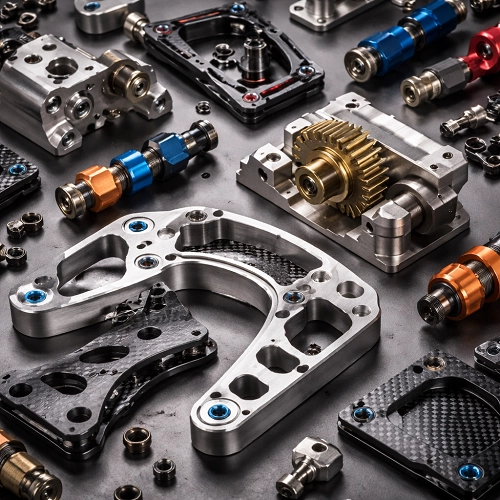
In engineering, manufacturing, and product development, the choice between standard and non-standard (also called custom) components is pivotal. It influences cost, lead time, quality, maintainability, regulatory compliance, and even end-user satisfaction. Although the terms may seem straightforward, the deeper implications are broad and intersect with design philosophy, supply chain strategy, and long-term product lifecycle management.
A standard component is a part that is designed and manufactured according to established industry, national, or international specifications. Common sources of standards include:
Examples include fasteners (bolts, screws, nuts), bearings, pipe fittings, resisters, capacitors, structural profiles, and electrical connectors.
Key Attributes:
A Non-Standard Assembly Parts is tailored to a specific application, project, or product. It does not follow a published standard and is typically created when no existing standard adequately meets the requirements.
Examples include:
Key Attributes:
Standard components are interchangeable across systems and manufacturers. For example, an M8 bolt from Vendor A fits as expected with a standard M8 nut from Vendor B.
This mitigates risk in assembly and maintenance.
Standards are backed by technical committees and testing procedures. This gives confidence in functional performance—critical in safety-sensitive systems.
High volume production drives down costs through economies of scale. Purchasing from multiple sources increases competition, further reducing price.
Availability from multiple manufacturers reduces dependency on single suppliers and improves responsiveness when demand fluctuates.
Some applications require unique geometries, tolerances, or materials that no existing standard covers.
Examples:
Custom parts can embody proprietary designs that differentiate a product in the marketplace.
Complex systems may require parts that blend multiple functions—something standard parts can’t offer.
| Aspect | Standard Components | Non-Standard Assembly Parts |
| Cost (Per Unit) | Generally lower | Generally higher |
| Lead Time | Short (stock items) | Longer (design + tooling) |
| Quality Certainty | High, due to established norms | Varies with manufacturer |
| Design Flexibility | Limited | Very high |
| Supply Chain Risk | Lower | Higher (single source risk) |
| Innovation Potential | Low | High |
Standard components usually have defined tolerance ranges. High-precision applications may require custom manufacturing processes that exceed typical standards.
Standard parts are often limited to conventional materials (e.g., common steels, aluminum, plastics). Custom components open possibilities for advanced alloys, composites, or specialized ceramics.
Using standard components facilitates upgrades and replacements over long product lifecycles. Custom parts may become obsolete or unsupported, creating maintenance challenges.
Custom components often require bespoke tooling, molds, dies, or fixtures—significant upfront investment.
Standard components are often eligible for automated, high-volume processes. Custom parts may necessitate low-volume, slower fabrication methods such as CNC machining, 3D printing, or manual finishing.
They often come with material certifications, lot traceability, and compliance documentation (e.g., RoHS, REACH, CE).
Quality assurance depends on in-house protocols and supplier processes. Additional testing—such as destructive testing, X-ray inspection, or custom qualification runs—may be required.
Standard parts may be cheaper upfront, but if they don’t meet functional requirements, the cost of failure can outweigh savings. Custom parts deliver fit-for-purpose performance, but at higher development cost.
High volume justifies custom tooling amortization; low volume may favor standard parts unless performance mandates dictate otherwise.
Standard components have broad supplier bases, enabling competitive bidding and redundant sources.
Custom parts may rely on a single vendor, introducing risk. Effective contract management and diversification strategies are crucial.
Easy to replace due to availability and interchangeability.
Replacement often demands lead time and inventory planning—especially for critical spares.
Industries like aerospace, automotive, medical, and nuclear have strict compliance regimes. Standard parts simplify certification; custom parts need documentation and validation which can extend development cycles.
The dichotomy between standard and Non-Standard Assembly Parts is more than a matter of nomenclature—it's a strategic engineering choice. Standard parts offer predictability, economy, and ease of procurement. Custom parts deliver tailored performance and differentiation. Successful products balance these forces to meet technical requirements, business objectives, and lifecycle considerations.